Writing is a constant process of transformation, an art where raw ideas pass through the fire of revision until they come out polished and bright. Writing content that shines is not only a matter of technique, but of patience, creativity, and the ability to put every word through a continuous process of refinement. And, if you think about it, it is not that far from what the alchemists did in their eternal hunt for the perfect transmutation.
They weren't chasing gold. They were chasing perfection
But let's not get ahead of ourselves. To understand how alchemy and writing connect, you have to remember that the old alchemists were not simply medieval would-be millionaires obsessed with metals. They weren't after gold. They were after perfection.
Paracelsus, one of the most influential alchemists, argued that alchemy was not just about transforming substances, but about untangling the hidden principles of nature and of the self. Every failed experiment was not a mistake, but one more step up the ladder toward knowledge. If that doesn't remind you of writing and deleting the same sentence five hundred times because it still doesn't sound right, then maybe you've never gone through the torture of editing your own work.
The alchemical manuscripts spoke of a long process full of failures. Exactly like when you try to write something brilliant and end up with a paragraph that reads like your tax return. Or worse: a blank page. Because, just as the alchemists believed that matter had to be purified over and over before reaching its highest state, writers know that what we write first is rarely what actually deserves to be read.

The transmutation of words: patience, fire, and will
Whether it's turning lead into gold or words into something that resonates, transmutation is an act of patience, fire, and will.
The alchemists burned things. Literally. We only do it with our drafts… most of the time.
But the process is the same: take something raw and put it through trials until you extract its purest essence. Alchemy was not only an experimental science, but a way of understanding the world. And writing, in the same way, is not just putting words together: it is a journey of discovery, transformation, and, sometimes, a touch of controlled madness.
The Tria Prima of Writing: the formula for the perfect content
The old alchemists held that all matter in the universe was governed by three fundamental principles: Sulfur, Mercury, and Salt. For them, these elements were not simple chemical substances, but essential forces of transformation.
As tempting as turning metals into gold was, the true quest of alchemy went much further: understanding the principles that rule nature and replicating its perfection. And, curiously, when we carry that idea over to writing, we discover that these same three alchemical principles define the creative process.
Because writing content that shines is not only a matter of talent or sudden inspiration, but of finding the balance between passion, flow, and structure. A good idea is not enough; you have to give it shape, movement, and solidity so it actually has value.
Sulfur: the creative fire of writing
Sulfur represented the volatile spirit, the spark of energy that set off any alchemical transformation. In writing, sulfur is pure inspiration.
That brilliant idea that hits you at the worst possible moment: in the shower, in the middle of the night, or right when you decide to leave the house without a notebook.
It's the flash of creativity, the fire that consumes the blank page and ignites the need to write. But the problem with sulfur is its instability. It appears out of nowhere, burns with intensity… and if you don't capture it, it vanishes.
That's why alchemists spent years perfecting their formulas to tame that volatile energy. And writers, although less prone to chemical explosions (in theory), do the same with our ideas: we trap them in notes, scribble incoherent phrases before bed, fill our files with names like "good idea FINAL V4 REALLY THIS ONE.docx" and learn to feed that spark without letting it consume us.
Because if sulfur gets out of control, it turns into smoke. And good content needs more than a spark to shine: it needs the right transmutation.
Mercury: the fluidity in writing that makes words shine
If sulfur is the spark that lights the flame, mercury is what keeps the story moving.
In alchemy, mercury symbolizes transformation, fluidity, and the ability to adapt. It's the element that lets substances move from one state to another without losing their essence.
In writing, mercury is the narrative. It's the rhythm, the tone, the style, the way you decide to tell a story. A writer with too much sulfur and too little mercury is like an alchemist who sets his lab on fire but has no idea what to do next.
Mercury gives the idea its shape, lets it flow naturally through the reader's mind. Without it, writing turns stiff, clumsy, a pile of loose sentences with no cohesion.
Because writing content that shines is not just about having a good idea; you need to find the exact rhythm for the words to flow like a river through the reader's mind, without stalling or overflowing.
The best alchemists knew that mercury could not be rushed. It flows at its own pace, like a story that needs to be told at the right time. Forcing it is like trying to write a novel in one afternoon because "you have the perfect idea."
Does it work? Only if the perfection you're after is a document full of jumbled sentences and an existential crisis at three in the morning.
Salt: the structure that holds the transformation together
Finally, we get to salt, the element that anchored the alchemical process in the physical world. Whereas sulfur and mercury were dynamic, ethereal, in constant motion, salt was the structure, the solid, what allowed the transformation to materialize.
In writing, salt is technique. It's grammar, punctuation, coherence, narrative structure. Without salt, writing turns inconsistent, confusing, unintelligible. It's like trying to build a cathedral out of jelly instead of stone.
Many writers fall into the trap of despising salt.
"Creativity doesn't need rules," some say, until they try to read something with no punctuation or structure and end up with a headache the size of the Great Work of alchemy.
But technique is not there to limit you; it's there to hold up what you create. It's the skeleton on which the fluidity of mercury and the energy of sulfur rest.
Because without structure, words can be beautiful, but they will crumble in the air like a misspoken spell.

The perfect balance: the great work of writing
This is where the real magic happens. Sulfur, mercury, and salt don't work separately. If you have too much inspiration but no structure, your text will be an unintelligible chaos. If you only follow rules without a creative spark, it will sound mechanical and soulless. And if everything is flow with no control, it will be like trying to write a novel with invisible ink: everything will flow… toward oblivion.
Because writing content that shines is not a matter of luck, but of finding the exact combination of these elements.
Alchemists spent their entire lives hunting for the perfect balance among these three principles, because they knew that without harmony, no transmutation was possible. And writers, without realizing it, do the same: we experiment, we fail, we rewrite. We burn drafts, distill phrases, and refine ideas until, suddenly, something shines.
Because, at the end of the process, what we're really after is not just writing… it's transforming.

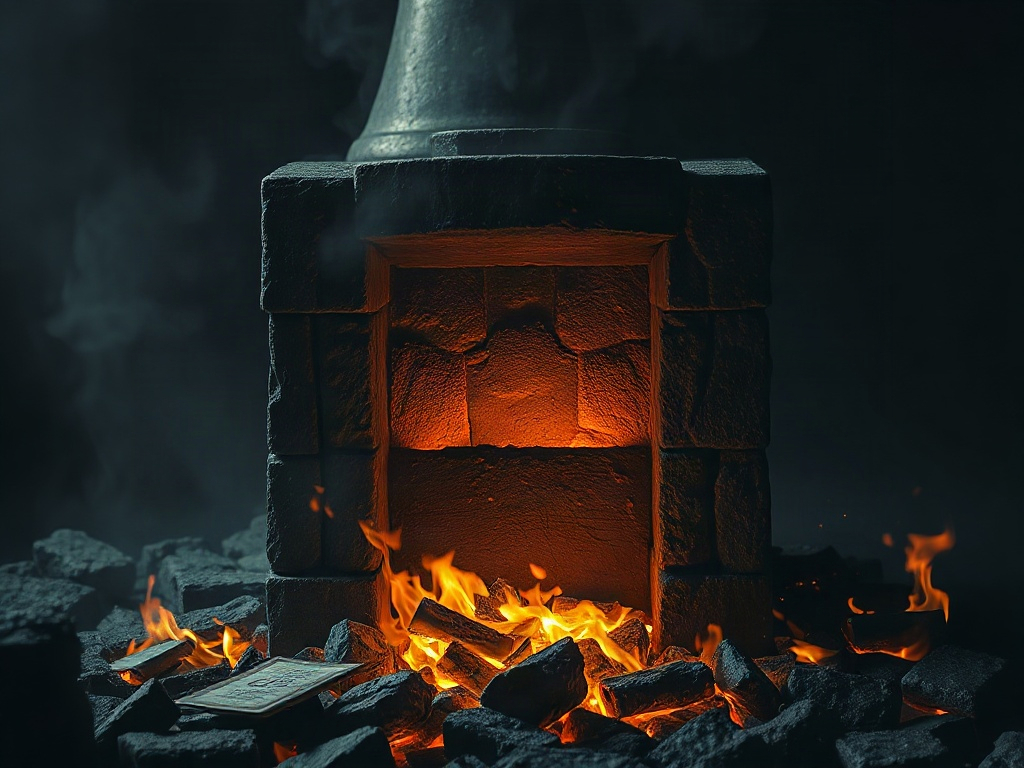
The Athanor: the laboratory where words shine
At the heart of every alchemical laboratory there was a sacred object: the athanor. It wasn't just any furnace. It was the crucible where matter was subjected to a constant fire, cooking slowly until it reached its final transformation.
An alchemist without his athanor was like a writer without his desk: a dreamer with no tools to materialize his vision.
The great alchemists of history, from Geber to Paracelsus, knew that transmutation did not happen in an instant, but in a meticulous, patient, and, above all, fiery process.
And in the world of writing, exactly the same thing happens. Writing content that shines is not only a matter of talent, but of subjecting every word to the combustion of the creative process.
The writer's athanor is not made of stone or metal, but of paper and keyboard. It doesn't run on coal or wood, but on ideas, discipline, and the will to endure the fire of rewriting.
Forging words in the fire of creativity
A writer doesn't put an idea on paper and leave it there, like an egg waiting to hatch into a dragon. No. You have to give it heat, mold it, work it over and over until it goes from lead to a golden ingot.
Just as alchemists spent years refining their formulas, we rewrite the same phrase over and over until it stops sounding like a microwave manual.
Texts are not born perfect. They simmer slowly in the athanor of editing.
The alchemy of writing: enduring the fire of the process
Paracelsus held that alchemy was not only about transforming metals, but also about refining the spirit. Applied to writing, that means every word burned in the editing process makes us better writers.
Every idea discarded, every crossed-out phrase is part of our creative evolution. Because the true transmutation does not happen in the first attempt, but in the fire of patience, sacrifice, and the will to improve.
The sacrifice of paragraphs: when the fire consumes what you love
Here comes the hard part. Transmutation hurts. It requires patience and resilience. It means killing paragraphs you loved, rewriting what you thought was perfect, and accepting that the first version of your text is, at best, an unshaped brick of lead.
The alchemist Nicolas Flamel, who supposedly cracked the secrets of the Philosopher's Stone, did not do it in a single attempt. His manuscripts were a compendium of errors, failed formulas, and constant adjustments. If he had given up at the first failure, his name wouldn't be synonymous with mystery and knowledge today.
The same happens to us as writers. Sometimes we write a phrase and feel it's pure gold… until we read it again the next day and realize it shines less than a mud-caked shoe.
The temptation to cling to our words is strong, but the alchemy of content demands sacrifices.
Because writing content that shines is not only a matter of inspiration; it's learning to let go, to release what doesn't work, to accept that the best version of a text is not the first, but the one that survives the flames of editing.
The writer's athanor is their desk, their routine, the number of drafts they're willing to burn before hitting the version that truly gleams.
There is no other way.
Literary transmutation is not for the impatient
Alchemy was an art that demanded faith, resilience, and an almost irrational obsession with perfection. The process of writing is no different.
We burn ideas, distill them, melt them, and reshape them. Every writing session is a new experiment in the athanor. Sometimes we blow up the entire laboratory, but when everything clicks… when the fire does its work… there it is: the gold.
And that's the true magic of writing.
Not in the first version, and not in the second. But in the one that rises after the sacrifice, turned into something truly worth reading.

The Four Elements of Alchemical Writing: the secret to writing content that shines
The alchemists believed that everything in the universe was made of four basic elements: earth, water, fire, and air. And although we now know the periodic table has quite a few more boxes, these principles are still essential to the transmutation of anything… including writing.
For an alchemist, achieving balance among the elements meant the success of the experiment. For a writer, that balance is the difference between a text that resonates and one that crumbles like a spiderweb in the rain.
The great work of writing is not built with inspiration alone, but with the exact blend of structure, flow, impact, and depth.
Earth: the solid foundation of every great story
If writing were a cathedral, earth would be the stone it stands on. It's the structure, the internal logic, the base that holds everything else up. A text without a firm foundation is like an alchemist without his athanor: no matter how much fire you throw at it, the result will be a pile of smoking rubble.
What does earth mean in writing?
- Evergreen content: texts that don't expire with time, that are still valuable years after being written. Like alchemical principles, they survive fads and fleeting trends.
- Internal coherence: a story without structure is like an alchemical manuscript full of disconnected symbols: it might look interesting, but nobody will understand it.
- Grammatical and stylistic rules: it's not about being a slave to the norm, but even the alchemists knew there were principles you couldn't ignore. A text full of errors is like a badly distilled elixir: it doesn't cure, it poisons.
Example of writing without earth
Imagine an article titled "How to Write Better." If inside there are only loose sentences, vague advice, and chaotic structure, reading it will be like walking on unstable ground. The reader won't be able to move forward without tripping.
Example of writing with good earth
Now imagine the same article, but well structured: clear introduction, progressive development, concrete examples, useful conclusion. Now the earth is firm. The reader can walk on it, move forward, understand.
The alchemists knew that without earth, everything disperses into the air. Writers should remember the same.
Water: the fluidity that brings words to life
If earth is the base, water is what gives it movement, what stops writing from being an inert block of marble.
In alchemy, water symbolized adaptability, constant change, the ability of a material to transform without losing its essence.
In writing, water is storytelling, tone, emotional connection. It's what lets a story flow naturally through the reader's mind, instead of getting stuck in heavy, rigid sentences.
What does water mean in writing?
- Narrative rhythm: a text without rhythm is like a dry river: hard to navigate and uninspiring.
- Empathy with the reader: a text that doesn't connect emotionally is like stagnant water: it's there, but it doesn't move anything.
- The author's tone and voice: every writer has a different flavor, just as every river has its own course.
Example of writing without water
Think of a badly translated instruction manual: rigid sentences, soulless, as if written by an automaton with an empathy deficit. It doesn't flow, it doesn't grip, it doesn't move.
Example of writing with water
Now imagine a story told naturally, that slides with just the right cadence, that invites you to keep reading without noticing the passage of time.
That's water in action.
Writing content that shines is not only a matter of structure; it's finding the rhythm that makes words flow and come alive in the reader's mind.
Summary: earth without water is barren, water without earth is a flood
A text with lots of structure but no flow is like arid ground: solid, but lifeless. On the other hand, a text full of emotion but no structure is like an unhinged torrent: striking, but chaotic.
The balance between the two is the key to true transmutation. The alchemists knew it. Writers should know it too. A solid foundation alone isn't enough, nor is prose that flows: we need the fire that transforms and the air that lifts.
Fire and air: the essence of memorable content
If earth is structure and water is flow, we're left with the most untamable elements: fire and air.
In alchemy, these two were the great catalysts of change: fire transfigures, air expands.
And in writing? They are the elements that turn a text into something unforgettable.
So here we go: the elements that truly transform a text and lift it beyond the ordinary.
Fire: the transformation that makes a text shine
Fire is the great revolutionary. Nothing stays the same after passing through it. In alchemy, it was the agent of transmutation par excellence: it melted metals, removed impurities, and purified matter until it reached its purest form.
In writing, fire is what turns a correct text into an unforgettable text.
What does fire mean in writing?
- It's the spark that turns the ordinary into the extraordinary. That unexpected twist, that striking image that burns into the reader's memory.
- It's the engine of interest. A text without fire is like a story told in a monotone: correct, sure, but incapable of holding attention.
- It's the risk, the courage to write something that shakes, that provokes a reaction.
Example of writing without fire
A flat, predictable article that follows the rules but awakens nothing in the reader. Like an alchemical potion missing its essential ingredient: the heat of transformation.
Example of writing with fire
Think of a text that grabbed you from the first sentence, that shook you with an unexpected revelation, that left a powerful image in your mind.
That's fire.
The alchemists knew that without fire there was no transformation.
Writing content that shines is not just about writing well, but about finding that spark that turns words into something the reader can't forget.
Air: the inspiration that lifts words
If fire is the flame that consumes and transforms, air is what lets everything fly higher.
In alchemy, air represented the subtle, the unreachable, the connection between the material and the divine.
In writing, air is what gives words their soul.
What does air mean in writing?
- It's abstraction, metaphor, conceptual elevation. Not everything has to be practical and concrete; sometimes the greatness of a text lies in what it suggests, not just in what it says.
- It's room for interpretation. A text with air lets the reader breathe, makes the words their own.
- It's inspiration, the wind that pushes a story beyond the obvious.
Example of writing without air
A text that says everything, with no room for the reader's imagination. Like a mathematical equation with no space for creativity.
Example of writing with air
A story that suggests more than it says, that leaves the reader with questions, with the sense of having touched something bigger than what fits in words.
That's air in action.
The alchemists saw air as the bridge between the earthly and the celestial. Writers should see it as the bridge between the word and the emotion.
The balance: the perfect combination for immortal content
- A text with lots of earth but no water is solid, but dry.
- A text with lots of water but no earth flows, but has no form.
- A text without fire can be correct, but never thrilling.
- A text without air can be clear, but never transcendent.
The balance among these four elements makes a text not only readable, but unforgettable.
The alchemists devoted their lives to finding the perfect combination of elements to achieve the supreme transmutation: the Philosopher's Stone.
Writers, in our own laboratory of words, seek the same.
Not to turn lead into gold… but to turn ideas into something that shines forever.
How to Write Immortal Texts: the Philosopher's Stone of Content
If alchemy had a supreme goal, it was the Philosopher's Stone.
The legendary object that promised perfect transmutation: turning metals into gold and granting immortality. For centuries, alchemists all over the world devoted their lives to deciphering its secrets, leaving behind treatises, symbols, and enigmatic manuscripts that still fascinate us today.
But what if I told you that writers also seek their own Philosopher's Stone?
We don't seek gold or eternal life.
What we really seek is the closest thing to immortality in the digital world:
Writing content that shines beyond time. That stays relevant. That gets read, shared, and remembered years later.
The obsession with the Philosopher's Stone: transmuting the ordinary into the extraordinary
From Geber, the Arab alchemist who laid the foundations of modern chemistry, to Isaac Newton, who devoted more time to alchemy than his official biographies let on, the hunt for the Philosopher's Stone was much more than a myth.
It was the idea that, with the exact combination of elements and processes, you could achieve absolute perfection.
In writing, that same principle applies to content.
Putting words together is not enough; you have to subject them to a process of refinement, of creative distillation, until they shine.
What looks spontaneous and natural in a masterful text has passed through the fire of the athanor dozens of times.
How to identify the Philosopher's Stone of Content
1. Valuable information: the base of pure gold
Immortal content is not built on passing trends, but on real value.
It's that article that is still useful five, ten years after being published.
Like the alchemical treatises that, centuries later, still inspire scientists and philosophers.
Example of ephemeral content
- An article about the best apps of 2023. In a year, it will be useless.
Example of content with the Philosopher's Stone
- An article about how to write impactful stories. That knowledge doesn't expire.
2. Immersive storytelling: the elixir of alchemical narrative
If information is the base of pure gold, storytelling is the transmutation process.
Without a powerful narrative, data is just unrefined chunks of metal.
The alchemists knew that symbols were key to passing on their knowledge. They didn't write flat, technical treatises, but texts loaded with metaphors, stories, and enigmas.
Good content does the same: it attracts, intrigues, and leaves a mark.
Example of text without storytelling
- A technical manual on how to use a tool. Functional, but soulless.
Example of alchemical content
- A story about how a writer found his voice after years of failure. Inspiring, memorable, with emotional connection.
The difference lies in emotional connection.
The secret of digital immortality
The alchemists believed that, once found, the Philosopher's Stone could replicate itself indefinitely.
The same happens with immortal content: when you achieve the exact combination of value, narrative, and structure, you create something that keeps generating impact over time.
Think about the texts you've read more than once, the ones you go back to, the ones that are still recommended years later.
That, reader, is the Philosopher's Stone of content.
Conclusion: the transmutation of words into literary gold
There was a time when the alchemists believed that, with the exact combination of elements and processes, they could turn lead into gold and reach immortality.
And although the Philosopher's Stone never appeared in medieval furnaces, the search was not in vain.
Because what they were truly chasing was not just a precious metal, but supreme knowledge, the ability to transform the raw into the sublime.
That, precisely, is writing.
Writing is alchemy, not because we seek literal gold (though that wouldn't be bad either), but because we seek perfection in transformation.
Turning raw ideas into texts that shine. Pulling beauty out of chaos. Finding rhythm in disorder.
We don't write just to fill pages, but to capture the fleeting, give it shape, and make it eternal.
Writing is alchemy: turning words into gold.
The alchemist-writer's process
Every word is raw material, every sentence an experiment, every draft an imperfect version that burns in the athanor of rewriting.
Sometimes, transformation hurts.
Like the alchemists who spent decades hunting for the perfect formula, writers know that magic only happens when we have the patience to polish, distill, and refine.
There are no shortcuts. There is no Philosopher's Stone that turns a text into gold without work.
The brightest idea without structure is just a flare that dies out. The best technique without soul is just a stone statue with no heartbeat. The most beautiful metaphor without coherence is just air with no substance.
When all the elements balance out, when inspiration, structure, emotion, and technique find their exact point of fusion, the true transmutation happens:
A text that lives beyond its author. That resonates. That gets shared. That leaves a mark.
And that's how you write content that shines.
The alchemist and eternity
The great alchemists died without seeing their promise of immortality fulfilled, but their legacy stands intact.
Writers aren't eternal either.
But our words can be.
And there lies the true Philosopher's Stone.
Not in an object, nor in a lost secret, but in the ability to transform the ordinary into the extraordinary, to bring life to what seemed inert, to make words transcend time.
Every time you sit down to write, remember: you are an alchemist. Every word you shape is part of your own Great Work.
Because in the end, well-wrought words transcend. And that is the true immortality of the writer.
What will be your next great transmutation in writing?
Did this piece resonate with you?
Leave your anonymous spark in the workshop if this reading brought you value.